Showing posts with label food and drinks. Show all posts

13 Oct 2011

Lucky 13: Women Writers about Wine.


"Wine is the refined jewel that only a grown woman will prefer to the sparkling trinkets adored by little girls."
- Muriel Barbery (Gourmet Rhapsody)

"Only a fool tries to reconstruct a bunch of grapes from a bottle of wine."
- Jeanette Winterson (Art & Lies)

"Wine talks; ask anyone. The oracle at the street corner; the uninvited guest at the wedding feast; the holy fool. It ventriloquizes. It has a million voices. It unleashes the tongue, teasing out secrets you never meant to tell, secrets you never even knew. It shouts, rants, whispers. It speaks of great plans, tragic loves, and terrible betrayals. It screams with laughter. It chuckles softly to itself. It weeps in front of its own reflection. It revives summers long past and memories best forgotten. Every bottle a whiff of other times, other places, everyone...a humble miracle"
- Joanne Harris

“There are days when solitude is a heady wine that intoxicates you with freedom, others when it is a bitter tonic, and still others when it is a poison that makes you beat your head against the wall.”
- Colette

"What I do, and what I dream include thee, as the wine must taste of its own grapes."
- Elizabeth Barrett Browning (Sonnets from the Portuguese and Other Poems)

"...and I get refill number three or four and the wine is making my bones loose and it's giving my hair a red sheen and my breasts are blooming and my eyes feel sultry and wise and the dress is water."
- Aimee Bender (Willful Creatures: Stories)

"All Creatures know that some must die
That all the rest may take and eat;
Sooner or later, all transform
Their blood to wine, their flesh to meat."
- Margaret Atwood

"I am a connoisseur of fine irony. 'Tis a bit like fine wine, but it has a better bite."
- Lynn Kurland (Princess of the Sword (Nine Kingdoms, #3))

"Language is wine upon the lips."
- Virginia Woolf

My writing is an overflow of the wine glass of my life, not a basin in which I wash out my ideals and expectations."
- C. JoyBell C

"Your divine should not have used water. It just doesn't hold the attention properly. Wine. Or blood, in a pinch. Some liquid that matters."
- Lois McMaster Bujold

"You are trying to lure us into revealing information you're not entitled to? With chocolate and wine? Are you amateurs?"
- Moira J. Moore (Heroes at Odds)

"I have dreamt in my life, dreams that have stayed with me ever after, and changed my ideas; they have gone through and through me, like wine through water, and altered the color of my mind."
- Emily Brontë (Wuthering Heights)

--------
Image: 'A Glass in The Hand...' by clappstar. Available under a creative commons license. © 2010, clappstar.
♥ Bookmark or share this post ♥

24 Aug 2011

Glorious Rheingau, Ravishing Rieslings.


Last week, on the way back from 'Holidays - the Sequel', we spent a few days at the river Rhine, in Germany's second oldest hotel: Hotel Krone near Rüdesheim-am-Rhein.

Over the past few years, we've developed a taste for Riesling wines, and after visiting the French Alsace last year, we wanted to continue our discovery of this wonderful grape, in the Rheingau this time.


The Rheingau ...

The Rheingau is one of Germany's smaller wine regions but an important one, especially for Riesling wines. The oldest documented references about Riesling come from this area, and the first vineyards have allegedly been planted as early as the 8th or 9th Century.

Schloß Johannisberg in Geisenheim is supposedly one of the places where it was discovered that grapes affected by Botrytis cinerea (pourriture noble or noble rot) made delicious sweet wines.

For these and many other reasons, the Rheingau had been on my to-visit list for a while, so when the opportunity arose, I couldn't let it pass.


The Hotel ...

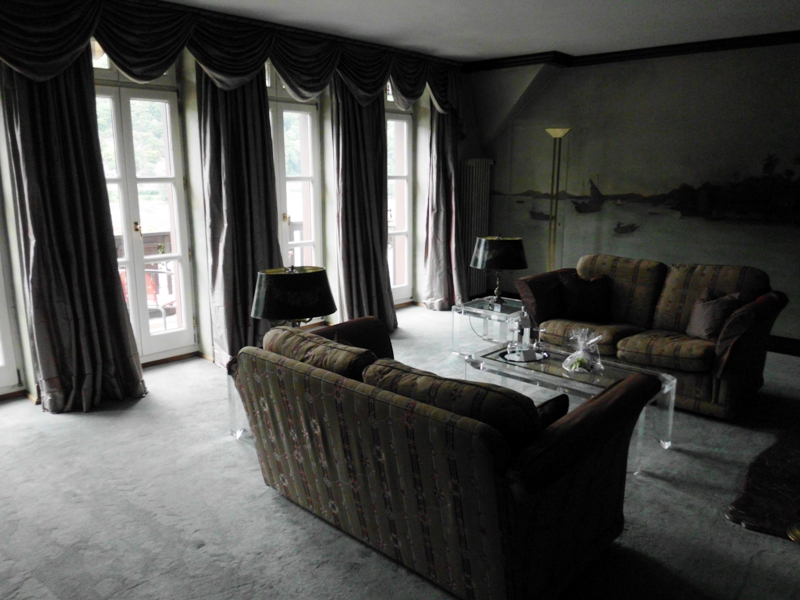
Hotel Krone is a charming, old-world boutique hotel, a bit outdated maybe but that only added to its character.

We stayed in one of their suites, with a wide balcony overlooking the Rhine and a huge marble bathroom, complete with private sauna and jacuzzi.

If we hadn't had all this wine-tasting and gastronomic dining on the agenda, we wouldn't have left the room.


I was glad we did venture out, though, because we discovered great wines in the Rheingau, in different price ranges, but nearly all of them of decent quality and fair value for money.


The Wine ...

We started our exploration with a visit to Schloß Johannisberg and a tour of the ultramodern Steinberg cellars at Kloster Eberbach. Afterwards we visited independent winemakers in the nearby towns.

It was interesting to see how in an area that's quite renowned for its wines, many of the local wine growers seemed to have little interest in actually selling their wines. One of them, when we asked if we could sample his wines, looked so surprised one would think he'd never had that request. He even had to check with his wife first, who wasn't home at the time.

When we came back a few hours later, he had recovered from the shock and sat down at the table with a couple of bottles. We ended up having a good chat and bought several of his wines: a lovely dry white, and his personal favourite: a medium dry weißherbst (a rosé made from one type of grape – pinot noir in this case – and harvested from one location). So everything worked out fine, but if we hadn't spoken German, we wouldn't have made it past the doorstep.

Now, my favourite discovery of the entire trip was Weingut Josef Leitz.

Not only were they incredibly accommodating by organising a short-notice private tasting for us; the guy who lead the tasting - Tobias, if I recall his name correctly - was friendly, welcoming, knowledgeable and clearly passionate about wine. He took the time to explain (in English, even) the individual characteristics of the vineyard's winemaking style and the different soils and 'Lagen' they worked with.

The Leitz tasting was one of the most enjoyable ones I've ever experienced. I can honestly say there wasn't a single wine I didn't like, even though they were all quite distinct. Leitz' wines are a perfect illustration of what a difference terroir makes in the final result.

Deciding which ones to buy became a true ordeal. Each of them unique, they all had an irresistible vigour and vibrance, intensely fragrant yet elegant, with a beautiful balance of acidity, minerality and luscious fruit.

After careful deliberation, we settled on one of his more modest dry ones for everyday consumption, and - for more special occasions - my favourite: the 2010 Rüdesheimer Berg Roseneck Spätlese, a sweeter wine with a delicate aroma of rose petals.

But before I get lost in lyrical outpourings, let me share a few photographs of:


The Rhine ...


The Wine Cellar ...


Zum Wohl!
♥ Bookmark or share this post ♥

21 Apr 2011

R is for Restaurant.

The Bar at The Horse & Groom. November 2010.

I love going out to dinner, especially to places that have a unique character. Fortunately I live in Belgium, in the heart of Europe, famous for its Burgundian lifestyle and surrounded by interesting culinary neighbours, each with a distinct focus and flavour.

A few days ago, the top 50 of the world's best restaurants was revealed, and I was happy to see that 2 of the top 20 restaurants were places I consider 'local'. Hof van Cleve - #15 and Oud Sluis - #17 are both less than an hour's drive away from where I live.

If I would ever get tired of those, there are 5 more top 20 restaurants in Paris, which is less than 3 hours away, and of course there's The Fat Duck in Maidenhead, just past London, about 4 hours.

My novel is set in the Cotswolds, so I spend quite a bit of time in England. I'm lucky to have great friends in the area, who love good food (and wine) as much as I do.

A few years ago, one of those friends introduced me to 'The Horse & Groom', a restaurant in the Cotswold village of Upper Oddington, England, and it's become my favourite in that area.

I've posted this review on my side-project blog 'The Enchanted Traveller' before, but in honour of my 'Restaurant' topic, I thought to give it a place here as well.

Part of the bar and dining area. Nov 2010.
There are so many aspects to 'The Horse & Groom' I like, it's hard to say what I like most.

First of all: it is cosy, with a relaxed and friendly atmosphere. Simon Jackson, the owner, welcomes his guests warmly and really goes out of his way to make you feel at home.

The inn itself is a 16th century building and its character has definitely been preserved, even though the interior has a more contemporary rustic touch now.

As soon as the weather gets damp or chilly, the fireplace is lit, which fills the space with a warm glow and a scent of burning wood that is just right for a perfect evening full of joy and good conversation.

Window seats near the fireplace. November 2010.
The seasonal menus offer a wide range of choices, without being so overloaded that it becomes difficult to choose.

Dinner menus contain about 6 to 7 starters, mains and desserts, and a few side orders. On top of these, there are daily specials on the board.

The vegetarian options are equally attractive, very well prepared and with the same amount of care put into flavours and textures as is the case with the other dishes.

The prices are fair, possibly at the higher end of what you'd expect in a village inn, but the quality of the food is so superb that what you pay is more than justified.

The chef, Jason Brewster, works with local produce as much as he can, and is committed to really cooking from fresh. As a result, everything you get on the table has been prepared in house and is just bursting with flavour. He and his kitchen team bake their own bread, make the stocks, sauces, chutneys, ice creams, puddings, even smoke the meats and fish.

Simon at work. November 2010.
This is all wonderful, but as far as I'm concerned, the characteristic that really sets the Horse & Groom apart is that Simon knows his wines. He knows them, and he loves them.

He will not push his knowledge on you or bore you with endless descriptions if you're not interested in wines, but when he spots that spark, and you get him talking, you immediately see that this is no marketing gimmick or put-on pretentiousness.

He genuinely cares, about the wines as well as the stories behind them: who has made them, what makes them special, and what you could drink them with to experience them in the best possible way.

The Horse & Groom offers over 25 wines by the glass, which gives you a lot of flexibility when you're dining with a smaller group - or if you just like variation.

To get an idea of the extensive selection, have a look at their wine list here.

(For completeness' sake: they seem equally passionate about their beers, but I'm more of a wine person so I can't speak from experience there.)

'Wine Staircase' in a cosy corner. Nov. 2010.
If you're in doubt which wine to choose, depending on what you like and/or what food you're having, you can always ask for advice. If someone else is taking care of your table, don't hesitate to ask if Simon would have a minute. He's definitely the man you'll want to talk to.

If you're getting a dessert, which I'd really recommend, you might want to consider one of the gorgeous 'sticky wines' to go with it. I think we've sampled the full range by now, and my absolute favourites are the Californian Quady 'Elysium' - Black Muscat, the Australian 'Cordon Cut' Clare Valley Riesling and the mouthwatering Pieropan 'Le Colombare'. These wines are truly liquid gold.

Before I get all lyrical, let me refer you to the Horse & Groom website for all the practical information you might need, and assure you that when you're in the Cotswolds, this restaurant is well worth a visit.

Even if you find you're not that close to Upper Oddington, you won't regret the detour. Do take someone who doesn't like wine, though. Chances are you'll need a designated driver!


What's your favourite restaurant?
♥ Bookmark or share this post ♥

9 Apr 2011

H is for Herbs.


About 15 years ago, after graduating from university, I studied herbalism for a few years. I wanted to be self-reliant when I was away from civilisation, to be able to treat minor injuries and discomforts myself, with what I found growing around me.

During the day, I worked in an independent bookstore. In the evenings, I took classes in physiology, botany, aromatherapy and phytochemistry.

It was a great time, even though I spent the bigger part of my early wages on herb books I didn't necessarily need.

About half of the course consisted of practical work. We made syrups, tinctures, elixirs, balms, oils and lotions. I imagined myself an alchemist, stashed away in a lab in a cobweb-ridden tower.

Other evenings were spent in the kitchen, where we learnt to chop and taste, cook and bake with herbs, flowers and roots. I dreamt of becoming a chef or opening a patisserie.

It didn't happen. I've never used those skills professionally, but I've continued experimenting, in the kitchen as well as in my improvised lab-under-the-stairs.

Today I want to share a few easy herbal recipes, using everyday ingredients.

Most of them make great presents. Find a nice bottle, make a vintage-style hand-written label (which you can personalise as you see fit) and decorate with a ribbon, raffia, flowers or sprigs of herbs. Or how about trying them out with friends or family during a well-deserved, health-inspired spring get-together?


Recipes

Herb-infused oil

Ingredients:
  • vegetable oil, enough to fill the container of your choice. Most food quality oils will do, but the milder the flavour, the more you'll taste the herbs.
    With mediterranean-style herbs like basil, thyme or oregano, I use a good olive oil.
  • fresh herbs. To give an idea of quantity: per cup of oil (roughly 250ml), I use about 1 cup of fresh herbs.
    I make this with either one herb or a mixture of several. My favourites are: thyme, tarragon, bay leaf, basil, rosemary, oregano, chillis and garlic. Lemon thyme and (a bit of) sage make a particularly good combination.
Recipe:
  • Wash the herbs and dry them well.
  • Gently bruise the herbs to help them release their flavour.
  • Put the herbs in a jar, add some fresh pepper.
  • Pour the oil over the herbs. (Some recipes want you to heat the oil. I don't do that. I'm not a fan of heating vegetable oils because it changes the nature of the fats.)
  • Close the container and keep in a cool, dark place for about a week. (Some recipes advise you to keep it longer. I find 1 week is enough; I prefer a more subtle herb flavour. You can taste in between to see if it needs a few more days.
  • Strain the oil and pour it in the container you've chosen. You can add a sprig of dried herbs, a few peppercorns and/or dried chillis for decoration and additional flavour.
Tips:
  • Choose a good quality oil. This will affect the outcome, as it's the main ingredient.
  • Experiment with different herbs and combinations.
  • After infusing the oils, don't keep them too long or they will turn rancid.
  • Adding some lemon zest to the recipe gives a nice tang.
  • You can make herb vinegars in quite the same way.
  • Use this recipe with just oil (e.g. almond or sesame oil - check for allergies first!) and calendula flowers (marigold) to make a great body or massage oil.

Herb-infused wine
  • To make a herb-infused wine, add cinnamon sticks, star anise, cloves, lemon or orange zest, ginger, lemon balm, ... to a bottle of white, red or sweet wine.
  • You can either heat the wine with the herbs (don't boil!) and then strain, or add the herbs to the bottle, close, and leave it standing. Taste regularly and remove the herbs if the flavour is strong enough.
  • I like to do this with mead or a nice-but-not-so-spectacular dessert wine, to give it more layers of deep and interesting flavour.
  • These wines make a great and cherished after-dinner drink. They improve your digestion and general well-being.

Avocado Face Mask

Ingredients:
  • 1/2 ripe, preferably organic avocado
  • 2 tablespoons of warm herbal tea (camomile for a soothing effect, peppermint to refresh)
  • 1 teaspoon of honey
Recipe:
  • Purée the avocado with honey and tea to a smooth mixture.
  • Apply to your face, avoiding the eyes.
  • Leave on for 10 minutes.
  • Rinse off with warm water, then once more with cold water.
Tips:
  • If you're concerned about allergies, test out the mixture on a small part of your skin (e.g. the inside of your wrist), leave it on for a few minutes, rinse off.
  • If you have some left: add onions, garlic and lime juice. Eat with nachos / corn chips. ;-)

Enjoy :-)
♥ Bookmark or share this post ♥

4 Apr 2011

C is for Chocolate.


I am a huge chocolate fan. I have some every day. To me, good quality chocolate is one of the few sweets that fits into a healthy lifestyle.

As a chocolade aficionado, I am lucky to live in Belgium, the tiny country in Western Europe that is the grand home of Belgian chocolate.

Today, I want to tell you a bit more about my favourite brand of Belgian 'pralines', Neuhaus.

Neuhaus is a Belgian manufacturer of luxury chocolates. The company was founded in Brussels over 150 years ago, and to this day, all of its chocolates are still made here, in Belgium.

The founder's grandson, Jean Neuhaus jr. created the first 'praline' - a bite-size, filled chocolate - in 1912. A few years later, he and his wife Louise also invented the 'ballotin', the typical box in which Belgian pralines are still sold today and which prevents them from being damaged.

What I like about Neuhaus - apart from their scrumptious chocolate - is that the company respects its roots and traditions, yet continues to innovate and come up with new chocolates and flavours.

An example is the charming collection of 'Lady Chefs' chocolates, each of them designed by a world-renowned female chef.

Neuhaus contends their chocolates are top quality, and I can vouch for that. With every bite, you taste the impeccable quality of their ingredients and the care they spend on matching the most exquisite flavours.

As an illustration, I recently noticed their 'Sommelier Collection' includes one of my favourite dessert wines, the 'Elysium' - Black Muscat I discovered in my favourite restaurant in the Cotswolds.

Now, quality of course comes at a price. These are luxury chocolates, with carefully selected ingredients, and that's reflected in what you will pay.

These pralines are more than just nibbles. They're small treasures, the kind you savour slowly, enjoying each of the different flavours and textures when they work their magic on your palate.

Before I tempt you with an extraordinary Easter egg, I want to share a few tips on how to recognise good quality chocolates and on how to get the most out of your (Belgian) chocolate experience.


How to recognise good quality chocolates:

Good chocolates:
  • have a pleasant, sweet smell; deep and complex but not overpowering.
    (Avoid chocolates that don't smell, or smell overroasted, chemical or stale.)
  • have a shiny, smooth, flawless and evenly-coloured surface.
  • begin to melt straightaway when you hold them in your hand. This indicates a high cocoa butter content, which is a sign of quality.
  • 'snap' when you bite through the outer chocolate layer.
  • have a complex, bittersweet, refined flavour, with sufficient acidity and a variety of textures that melt and blend into a smooth cream in your mouth.
  • have a taste that lingers.

How to get the most out of your Belgian chocolates:
  • Store them between 15 and 18°C (59 - 65°F), away from moisture, heat and strong smells. Don't keep them in the fridge.
  • Depending on the type of filling, after opening the box, pralines will last for about a week.
  • Ideal tasting temperature: 20°C (68°F)
  • Give them your full attention when you devour them. Enjoy them with all your senses.
  • Share them with people you love, especially if your loved ones appreciate great chocolate.

For gorgeous pictures, more information about chocolates and how they're made, and the places where you can buy them, go to the Neuhaus website or their extensive B2B catalogue.

If you'd have trouble deciding between all that scrumptiousness, my personal favourites are 'Les Irrésistibles', a collection of 5 triangular chocolates called Caprice, Tentation, Séduction, Désir and Plaisir.

Each of these pralines contains a layer of nougatine and is filled with either vanilla cream, coffee ganache, raspberry cream, dark chocolate ganache or hazelnut ganache.


And now for the Easter egg ...

If you happen to be near the Neuhaus store in Ghent, Belgium (Koestraat 50) - or any of the bigger Neuhaus shops - with a spare 250€ in your pocket, you might want to get this giant handmade, limited-edition Easter egg. Six kilos of fabulous chocolate and gianduja indulgence. Wouldn't that make a perfect gift for ... hey, me!

♥ Bookmark or share this post ♥

6 Mar 2011

From Basil to Bottle Bondage.


With spring so close, it's time to start thinking about the garden. I'm a city dweller, but we're lucky to have a patch of land to grow things.

Most of it is taken up by a herb garden. I love cooking as well as pottering around, which makes growing herbs and using them for food, drinks, cosmetics and medicinal concoctions the perfect hobby for me. I trained as a herbalist many years ago, and even though I've never practised it professionally, I still like to put those skills to good use.

Recently, inspired by sites like Urban Gardens and You Grow Girl, I've started thinking about time- and space-efficient ways of growing our own food, even - or especially - when living in a city.

Yesterday, I've worked on an urban gardening experiment of my own: trying to grow basil upside down.

I've killed a lot of basil plants in the past. They don't like to grow in open ground here, and on top of that, as soon as I plant them out, the local slugs gather en masse, conquer any defences I've provided and raze my brave little basil babies to the ground.

Well, not this time. They can besiege all they want, seize they will not.

Hopefully the basil will live happily ever after, at least until I appear with eager scissors. Snip snip!


Any gardening tips and tricks? Share them in the comments!

♥ Bookmark or share this post ♥

19 Dec 2010

Rum Nom Nom...


Isn't it beautiful? The essence of summer captured in a stoneware jar. And what better time of the year to open it and savour the aromas of fruits, herbs and spices. If sunlight had a scent, this would be it!

The journey started last spring, when I got a rumtopf (the jar) from my father-in-law. He wasn't using it himself and thought I might. Not entirely an unselfish gift, I suspect, but much appreciated nonetheless.

I started it in late May with the first strawberries from my parents' garden and a few fresh herbs. In the following months I've added raspberries & more strawberries (both grown by my mum & dad), cherries and plums (from our own trees) and peaches and nectarines (store-bought).

The last batch of raspberries were added mid October, and I've let the rumtopf sit and ripen until now. Well, actually until last night, because we had a sneak peak and a quick taste to avoid disappointment during the grand opening today.

Oh yes, the recipe.

Honesty requires me to admit that I haven't followed any recipe religiously. As is usually the case with any of my kitchen or herbal experiments, the types and amounts of ingredients I've added after the start depended more on instinct and availability than on measured amounts. But that was the original idea behind rumtopf anyway, wasn't it?

The only thing I didn't mess with was the strength of the rum. Not only is that a matter of principle, but you need to get 54% vol. alc. or you risk decay.

Typically rum here is around 40%, so I've added food grade ethanol (94%) to get to the desired 54%.

 
Ingredients:

- 1 vanilla pod (sliced in 2 halves & scraped out)
- 1 sprig of rosemary
- 1 sprig of lemon balm
- rum (I used Havana Club Añejo Especial and a 5 year old Barbados Rum)
- cane sugar
- strawberries
- raspberries
- cherries
- plums
- peaches
- nectarines
Process:

- Use a big vessel. Wash it (I used soda + boiling water), rinse and dry.

- Put the herbs & spices in the pot. I'd strongly recommend adding a vanilla pod. You only detect a hint of it in the final result, but it's one of those little things that makes a difference.

- Choose ripe fruit, but not overripe. It's a matter of balance, really: it has to be ripe enough to be full of flavour, but still firm or it will turn soggy in the alcohol and give an unappealing end result.
I started with strawberries (about 500g) and raspberries (about 250g).

- Wash the fruit and clean it up, cutting out the overripe or damaged parts and removing stalks etc.

- For the 750g of fruit, I used 375g of cane sugar. Pour half of that sugar over the fruit and (carefully!) scoop it under. Try not to damage the fruit. Leave it for an hour and add the rest of the sugar.

- Pour ho-ho a bottle of rum (0,7l) over the fruit. It should be fully covered.
You'll find that some of the types of fruit will float to the top. I used two small plates (that just fit through the opening of the jar) and tried to lower them as level as I could onto the fruit. It never worked perfectly, but at least most of the fruit stayed underneath, and the alcohol should take care of the rest.

- For the consecutive layers, the original recipe(s) recommended adding 500g of a different fruit, 250g of sugar and half a bottle of rum each time, but as I've said above, I've played that more by ear, except for the 54% alcohol. There's no need to peel peaches, nectarines, plums, etc, as the skin softens up in the alcohol and adds an interesting bite.

- It's recommended to keep the rumtopf cool, not cold, and properly sealed. I used cling film and then put the lid on top. The jar got a corner of its own on a shelf in the cellar.

- Usually the last layer is added in October, after which it should sit for a while, to be ready for relishing by the darkest days of the year.

How to serve:

So far, we've only just sampled our rumtopf pure. Great, but be warned: it's bloody strong stuff. We had pink champagne biscuits with them (biscuits roses de Reims) and that was a great match. Who says France & Germany don't mix?

I expect it to taste great on different kinds of desserts: ice cream, frozen yoghurt, cake, cheesecake, pancakes, Belgian waffles, etc. I can imagine the drained fruit is also brilliant for fruit crumbles, pies or trifles and with regular, whipped or coconut cream. Apart from coconut cream, that's all stuff I don't have often, but I think I'm going to have to make a few exceptions here.

We're definitely going to try the liqueur in sparkling wine, white wine and experiment with different cocktails.

A few concluding thoughts:

It's so easy to do, and more fun than I'd anticipated, knowing that you're saving a bit of summer for the times when you'll need it most. Also, the fact that you've 'worked' on it over a period of 6 months, makes it quite special and symbolic.

I have a feeling that, providing you start of with a clean jar, firm fruit and you stick to the minimum alcohol percentage, it can't really go wrong. Mind, as this was my first try, that feeling might not correspond with scientific reality.

I've kept the most important bit for the end: when you serve your rumtopf, don't forget to toast to everything you've harvested over the past year: what you have accomplished, the people you've met, the lessons you've learnt and the joy and wonder you've felt.

Whatever the new year will bring, we'll be stronger to deal with it when we're grateful and aware about what we have right now. Cheers!

Rumtopf and pink champagne biscuits.

♥ Bookmark or share this post ♥

(Inter)national Rumtopf Day!

I declare today... Rumtopf Day.

After six months of gathering, cutting, adding, pouring and most of all waiting, this is the day the rumtopf will be opened. A happy and much anticipated occasion indeed.

It's a bit too early in the day to have a go at it already, so it's still safely stacked away in its little corner in the cellar.

Stay tuned for more news about the Official Opening later today.

(Recipe and more pictures here.)
♥ Bookmark or share this post ♥

15 Dec 2010

Midnight Blue(s) Margaritas.

At this very moment, my novel's main character is having Midnight Margaritas with a few friends, and I had to test the magical formula to make sure it was just right for the occasion. I'm not going to add the recipe to the story, but still, I like to do my research properly. Not an easy life, being a writer on sabbatical...

As an extra challenge, the drink had to be blue. You're free to ask why, but I can't tell you just now. The fact that I'd run out of Cointreau wasn't the only reason. Really.

Either way, here's the recipe, and a glimpse of how it turned out:

Ingredients:
50ml tequila
30ml blue curaçao
juice of 3/4 of a lime
tiny dash of cane sugar syrup
ice cubes
some coarse salt (I used fleur de sel)

How to make it:
- Add ice cubes, tequila, blue curaçao, lime juice and cane sugar syrup in a blender.
- Quote the 'Eye of newt, toe of frog' lines from Macbeth while waving your arms and hands in a most mysterious way.
- Blend.
- Cut the remaining 1/4 of a lime in 2 pieces. Use one to wet the rim of the glass and dip the glass in the salt.
- Add the lime pieces to the glass (and another ice cube if you prefer) and pour the blended mixture over them. Done!

I think a blue margarita makes the perfect accessory to my writing desk. Wouldn't you agree?


Right. No more procrastinating for me. Back to the novel!
♥ Bookmark or share this post ♥

1 Dec 2010

Om Nom Nom... More Inspiration for the Holidays!

A few days of blog silence usually means the novel is going well, and I'm glad to say it is. After a few weeks of rethinking backstory, plot and final outcome, I'm finally writing again. It took some perseverance, but the end result, if I dare say, will be much better for it.

In the past few days, my street, house and garden have turned into a gorgeous cotton candy Winter Wonderland. The darkest time of the year is near, and you can see and feel it everywhere. To compensate, I allow myself a bit of comfort food while I'm huddled up with my laptop in our warm and cosy living room, surrounded by lots of candles.

The sweet treat that - to me - is most typical for this season is gingerbread, in all its forms: there's our Belgian variety called 'peperkoek', there's the French 'pain d'épices' or the German 'Lebkuchen', each with its own particular texture, flavour and aromas.

I actually love the scent of gingerbread more than its taste, and I tend to use the typical spices in many other dishes: apple crumble, nut bread and several types of hot drinks, like tea, hot chocolate and of course mulled wine. It's a great way to make sugar-free (or sugar-reduced) desserts seem just that little bit sweeter.

A few days ago, I found the best gingerbread shape I've ever seen. Seriously, how cute is this:


Photo credit: Megan of notmartha.org

These gingerbread houses were made by Megan of http://www.notmartha.org/, and you can find the full instructions + more gorgeous photographs here.

She's also come up with several variations, like these, with tiny chimneys on snowy rooftops:

Photo credit: Megan of notmartha.org

I'm sure they will require some practice before they'll be anything like the ones on the pictures, but looking at the instructions, it actually looks feasible! And there are so many ways in which you can add your own touch, in the recipe as well as the decorations.

Actually, you can probably make these to fit on a glass of sweet wine as well. Gingerbread would be a great match for a sweet Muscat, a Sauternes, a dessert Riesling or a Macvin du Jura!

My heartfelt thanks to Megan for this great idea and the kind photo permission.
♥ Bookmark or share this post ♥

21 Nov 2010

Wine, Wine, Wine.

I've been quiet on the blog all weekend, but I've got the best excuse in the world: I was in Lille at the 'Salon des Vins des Vignerons Indépendants', known in short as 'the Lille Wine Fair'.

The 'Salon des Vins' is an annual event that takes place in different cities all over France. The fair is organised - as you can guess from its name - by the association of the French independent wineries. We've been going there for several years now, and I love it, in spite of the fact that it seems to attract more visitors every year and it's gradually getting a bit too crowded. Not so good for the visitors, but great for the wineries, of course.

The fair is absolutely huge. There were over 500 wineries present this year, and they all bring a number of their available wines for the visitors to taste and possibly buy.
You can meet wine makers from the different wine regions all over France, each with their own personal style and flair, in their wines as well as in how they present themselves to you. And to me that's one of the great advantages here: you get to see the people behind the wines and the pride they have in their products and their businesses that often go back several generations.
♥ Bookmark or share this post ♥

10 Oct 2010

Cider, sushi and Sunday aperitifs.

Another lovely sunny day today, which I wanted to celebrate with a healthy pre-dinner drink, especially after last night's (Somerset) cider tasting.

Two dear friends had got us the ciders (3 kinds: Cox's, medium dry and oak matured), and after a bit of doubt what food we'd pair them with, we decided on sushi.
 
I tried to make sushi for the first time about a year ago, and found out that - once you get the hang of it - it's not really that hard.

Of course I wouldn't compare mine to anything made by a real sushi chef, but for 'regular home consumption' they're pretty good.

On top of that they're fun to experiment with, they're healthy, made with a variety of good quality fresh ingredients ánd my immediate environment loves them, which is what matters most, really.

Pairing sushi with those exquisite ciders was a bit of an experiment, but we were surprised at how well it worked. Definitely something we'll be doing again!

But this morning I felt like a healthy, refreshing, sugar- and alcohol-free aperitif, so I decided to go for one of my (as yet unnamed) classics. Name suggestions are always welcome, by the way.

Here's how to make it:

  1. Take a long-drink glass
  2. Add an ice-cube if you want (I would do this in summer, I didn't now)
  3. Add a splash of grapefruit juice
  4. Add a splash of lemon (or lime) juice
  5. Top up with sparkling water
  6. If you have a sweet tooth: add a bit of natural sweetener. (I use stevia).
  7. Stir and taste if it needs more grapefruit, lime or sweetener
  8. Add a splash of carrot juice for the taste and the orange gradient effect.
(Use freshly squeezed juices if possible, but bottled will do, as long as it's got no added sugar. You don't need a lot of juice, it's just a bit for the taste and the colour, so this drink isn't high in fructose either.)

Enjoy!
♥ Bookmark or share this post ♥
Related Posts Plugin for WordPress, Blogger...